
Both Hindu and Muslim parties involved in the Gyanvapi dispute have rejected the Supreme Court's mediation initiative, stating that the matter should be resolved through judicial adjudication. This decision came during a session at a Varanasi court, where both sides expressed their preference for a court verdict over an out-of-court settlement.

Efforts to resolve three major religious site disputes in Uttar Pradesh - Gyanvapi, Sri Krishna Janmabhoomi-Shahi Eidgah, and Sambhal Shahi Jama Masjid - through out-of-court settlements have failed, with all parties insisting on judicial adjudication.
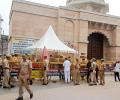
The Muslims side said that they have received the letter and it will be deliberated upon in a meeting.
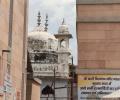
The Supreme Court's 2023 order refusing to stay a scientific survey at the Gyanvapi Mosque complex has sparked claims over several other disputed places of worship across India. This has led to several court cases, including one in Mathura where a survey of the Shahi Idgah Mosque complex was ordered, and another in Ajmer where a claim was made that a Shiva temple existed within the dargah of Sufi saint Moinuddin Chishti. The article also highlights a dispute over the Bhojshala in Madhya Pradesh, which Hindus consider a temple and Muslims consider a mosque. The Supreme Court's order has reignited debates about the Places of Worship (Special Provisions) Act, 1991, which prohibits the change of character of religious places as they existed on August 15, 1947.

Hindu women plaintiffs who have filed a civil suit before the Varanasi court seeking declaration and asserting the right to darshan and worship Hindu deities whose idols are located on an outer wall of the Gyanvapi mosque in Varanasi has referred to stand taken by the British government in a 1936 suit seeking it to be declared as Waqf property.
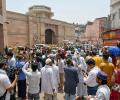
The Supreme Court on Friday agreed to hear an appeal of the Gyanvapi management committee against an Allahabad High Court order which held that lawsuits for "restoration" of a temple where the mosque stands in Varanasi are maintainable.
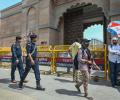
The Varanasi district court on Tuesday ordered that seven cases of the same nature related to the Gyanvapi dispute will be heard together.

'We have devotion towards Gyanvapi so doing something as per that, it's all right. But why look for a Shivling in every masjid?'
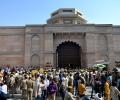
The Supreme Court on Monday agreed to hear a plea on a dispute involving the Gyanvapi mosque in Varanasi on November 10.
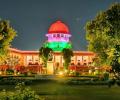
The Supreme Court has agreed to list for final hearing the pleas challenging the validity of certain provisions of the Places of Worship (Special Provisions) Act, 1991.

The petitions filed by the Anjuman Intezamia Masjid Committee (AIMC) and the Uttar Pradesh Sunni Central Waqf Board had also challenged a Varanasi court order of April 8, 2021 to conduct a comprehensive survey of the Gyanvapi mosque.

The Hindu litigants claim the mosque holds signs suggesting that it was a temple once.
District judge A K Vishvesh on Friday directed the ASI to conduct a detailed scientific survey -- including excavations, wherever necessary -- to determine if the mosque in Varanasi in Uttar Pradesh is built upon a temple.
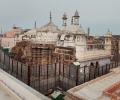
Advocate Madan Mohan Yadav, who is representing the Hindu petitioners, said, "The report in sealed cover was placed before the court by the ASI's standing counsel Amit Srivastava."
The Allahabad high court reserved its judgment on Friday in a petition challenging the maintainability of a suit seeking 'restoration' of a temple at the site of the Gyanvapi mosque in Varanasi.
The Supreme Court of India will hear a plea from the mosque management committee challenging an order rejecting its petition in the Krishna Janmabhoomi-Shahi Idgah dispute in Mathura, Uttar Pradesh on January 15. The Allahabad High Court had rejected the mosque committee's plea, stating that the religious character of the Shahi Idgah mosque needed to be determined. The case involves claims that the mosque was built after the demolition of a temple, a claim disputed by the mosque committee. The Supreme Court will now decide on the maintainability of the mosque committee's plea.
Earlier on Wednesday, the district court ruled that a priest can perform prayers before the idols in a cellar of the Gyanvapi Masjid, a significant development in the legal battle over the mosque adjacent to the Kashi Vishwanath temple.

The Varanasi district court arrived at the decision of allowing 'puja' in a Gyanvapi mosque cellar in "haste", the All India Muslim Personal Law Board (AIMPLB) said on Friday, asserting it would pursue the matter right up to the Supreme Court.
In a major victory for the Hindu side, a Varanasi court on Wednesday allowed Hindu devotees to offer prayers inside the 'Vyas ka Tekhana' area inside the Gyanvapi mosque complex.
According to the counsel for the Hindu side Madan Mohan Yadav, the ASI sought more time due to non-availability of the technical report.

Amidst the controversy over the Gyanvapi Mosque complex in Varanasi, Uttar Pradesh Chief Minister Yogi Adityanath has said that labelling Gyanvapi as a mosque complex will only lead to controversy and that the Muslim side should accept its 'historical mistake' and offer a solution.
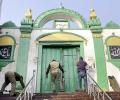
With the Uttar Pradesh Assembly polls scheduled for 2027, political experts are observing an increasing trend of temple-mosque disputes in the state, leading to heightened polarization. Recent bypolls saw the use of divisive slogans, and analysts believe this trend will intensify as the 2027 elections approach. The recent surge in claims about the existence of Hindu temples at the sites of mosques in various cities has fueled this polarization. The BJP-led government has been accused of promoting communal polarization, while opposition parties like the SP have criticized the ruling party's actions. The RSS chief has called for restraint in raising new temple-related disputes. Experts predict that communal polarization is likely to escalate in the coming days.

The Archaeological Survey of India (ASI) began working on a scientific survey of the Gyanvapi premises in Varanasi on Friday to determine whether the 17th-century mosque was constructed over a pre-existing structure of a Hindu temple.

Prayers were performed in a cellar of the Gyanvapi mosque in Varanasi on Wednesday night following court orders allowing the resumption of a practice said to have been discontinued three decades back, Kashi Vishwanath temple trust president said.

The ASI told the court on November 2 that it might take some more time to compile the report, along with the details of the equipment used in the survey work, following which additional time till November 17 was granted for the submission of the document.

Judge Ravi Kumar Diakar, who had ordered the video survey of the Gyanvapi mosque complex in Varanasi, informed the Uttar Pradesh authorities on Tuesday that he had received a hand-written threat letter.

A 30-member Archaeological Survey of India team halted a survey here of the Gyanvapi mosque -- just hours after beginning the exercise Monday morning -- following a Supreme Court order.
A fast-track court on Monday postponed till November 17 its judgment on a plea seeking permission to allow the worship of a 'Shivling' claimed to have been found inside the Gyanvapi mosque complex in Varanasi.
The photocopies have to be verified by the district judge, the high court said.

The committee takes care of 22 mosques, including the Gyanvapi Masjid, in the city and it has been presenting the Muslim side in the Gyanvapi mosque-Shringar Gauri complex case.
In an unusual coincidence, the two judges of a Supreme Court bench hearing a plea against the survey of the Gyanvapi-Shringar Gauri complex in Varanasi have had an association with a similar kind of dispute relating to the Ram Janmabhoomi-Babri masjid issue as well.
In a relief to the Hindu side, the Supreme Court on Friday refused to stay the Allahabad high court order allowing the Archaeological Survey of India (ASI) to conduct a scientific survey at the Gyanvapi mosque complex to determine if the 17th-century structure was built upon a pre-existing temple.
A court in Varanasi on Friday directed the Archaeological Survey of India to conduct a "detailed scientific survey" -- including excavations, wherever necessary -- to determine if the Gyanvapi mosque located next to the Kashi Vishwanath temple is built upon a temple.
The petition seeks the court's permission for worshipping the idols of the Hindu deities located on an outer wall of the mosque on a daily basis.
Several sculptures of gods and goddesses along with other structures related to Hindu motifs were seen in the Gyanvapi mosque in Varanasi, said advocate Ajay Kumar Mishra, who was appointed commissioner by a Varanasi court to survey the Gyanvapi-Gauri Shringar complex but was later removed for leaking the information.
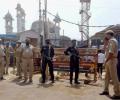
The order was passed by Justice Prakash Padia, who was hearing a petition filed by Anjuman Intazamia Masazid, Varanasi.
The court has also directed all concerned parties to file objections to the report submitted by the commission that surveyed the mosque premises.
A Varanasi court on Thursday rejected the Gyanvapi masjid committee's objection to a petition seeking the right to worship a 'Shivling' claimed to have been found in the mosque complex, and fixed December 2 for hearing the case.
A bench comprising Chief Justice DY Chandrachud and Justice PS Narasimha and Justice JB Pardiwala took note of the submissions of lawyer Vishnu Shankar Jain that the district judge of Varanasi has deferred five times the decision on a plea seeking clubbing of all civil suits pertaining to the dispute.
The Muslim side in the Gyanvapi mosque-Shringar Gauri complex case on Thursday filed an objection in the court against the Hindu plaintiffs' plea for the carbon dating of the "Shivling" claimed to be found on the masjid premises.
